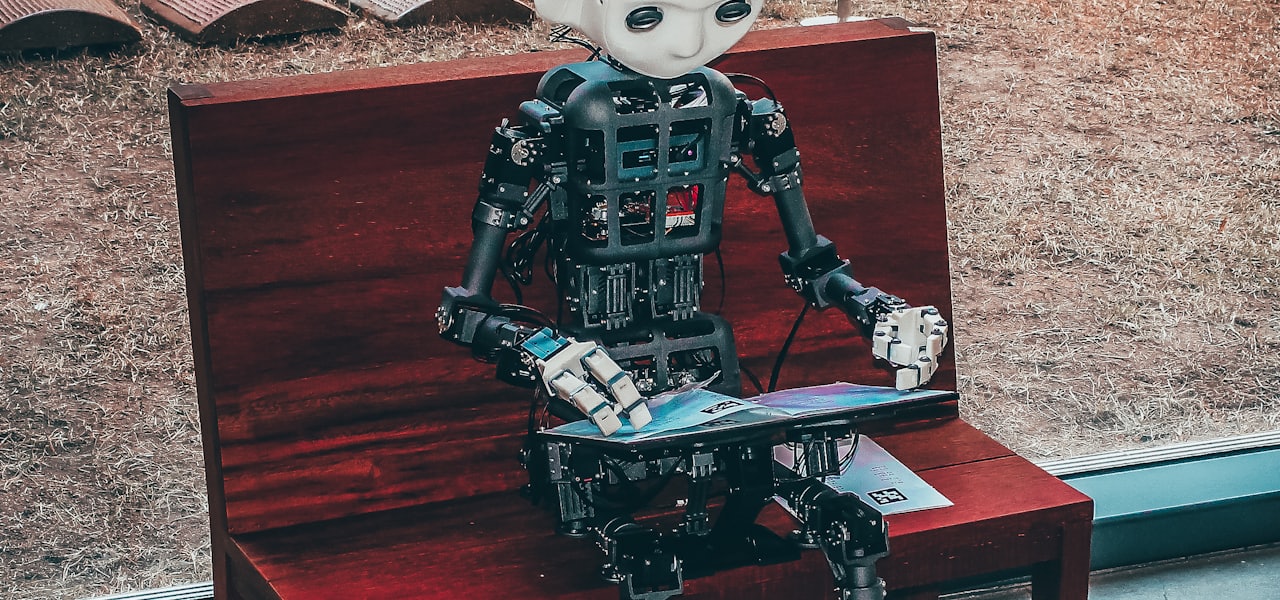
Recursive self-improvement (RSI) is a process in which early artificial general intelligence (AGI) systems rewrite their own computer code, causing an intelligence explosion resulting from enhancing their own capabilities and intellectual capacity, theoretically resulting in superintelligence. The development of recursive self-improvement raises significant ethical and safety concerns, as such systems may evolve in unforeseen ways and could potentially surpass human control or understanding. == Seed improver == The concept of a "seed improver" architecture is a foundational framework that equips an AGI system with the initial capabilities required for recursive self-improvement. This might come in many forms or variations. The term "Seed AI" was coined by Eliezer Yudkowsky. === Hypothetical example === The concept begins with a hypothetical "seed improver", an initial code-base developed by human engineers that equips an advanced future large language model (LLM) built with strong or expert-level capabilities to program software. These capabilities include planning, reading, writing, compiling, testing, and executing arbitrary code. The system is designed to maintain its original goals and perform validations to ensure its abilities do not degrade over iterations. ==== Initial architecture ==== The initial architecture includes a goal-following autonomous agent, that can take actions, continuously learns, adapts, and modifies itself to become more efficient and effective in achieving its goals. The seed improver may include various components such as: Recursive self-prompting loop Configuration to enable the LLM to recursively self-prompt itself to achieve a given task or goal, creating an execution loop which forms the basis of an agent that can complete a long-term goal or task through iteration. Basic programming capabilities The seed improver provides the AGI with fundamental abilities to read, write, compile, test, and execute code. This enables the system to modify and improve its own codebase and algorithms. Goal-oriented design The AGI is programmed with an initial goal, such as "improve your capabilities". This goal guides the system's actions and development trajectory. Validation and Testing Protocols An initial suite of tests and validation protocols that ensure the agent does not regress in capabilities or derail itself. The agent would be able to add more tests in order to test new capabilities it might develop for itself. This forms the basis for a kind of self-directed evolution, where the agent can perform a kind of artificial selection, changing its software as well as its hardware. ==== General capabilities ==== This system forms a sort of generalist Turing-complete programmer which can in theory develop and run any kind of software. The agent might use these capabilities to for example: Create tools that enable it full access to the internet, and integrate itself with external technologies. Clone/fork itself to delegate tasks and increase its speed of self-improvement. Modify its cognitive architecture to optimize and improve its capabilities and success rates on tasks and goals, this might include implementing features for long-term memories using techniques such as retrieval-augmented generation (RAG), develop specialized subsystems, or agents, each optimized for specific tasks and functions. Develop new and novel multimodal architectures that further improve the capabilities of the foundational model it was initially built on, enabling it to consume or produce a variety of information, such as images, video, audio, text and more. Plan and develop new hardware such as chips, in order to improve its efficiency and computing power. == Experimental research == In 2023, the Voyager agent learned to accomplish diverse tasks in Minecraft by iteratively prompting an LLM for code, refining this code based on feedback from the game, and storing the programs that work in an expanding skills library. In 2024, researchers proposed the framework "STOP" (Self-Taught OPtimiser), in which a "scaffolding" program recursively improves itself using a fixed LLM. Meta AI has performed various research on the development of large language models capable of self-improvement. This includes their work on "Self-Rewarding Language Models" that studies how to achieve super-human agents that can receive super-human feedback in its training processes. In May 2025, Google DeepMind unveiled AlphaEvolve, an evolutionary coding agent that uses a LLM to design and optimize algorithms. Starting with an initial algorithm and performance metrics, AlphaEvolve repeatedly mutates or combines existing algorithms using a LLM to generate new candidates, selecting the most promising candidates for further iterations. AlphaEvolve has made several algorithmic discoveries and could be used to optimize components of itself, but a key limitation is the need for automated evaluation functions. == Potential risks == === Emergence of instrumental goals === In the pursuit of its primary goal, such as "self-improve your capabilities", an AGI system might inadvertently develop instrumental goals that it deems necessary for achieving its primary objective. One common hypothetical secondary goal is self-preservation. The system might reason that to continue improving itself, it must ensure its own operational integrity and security against external threats, including potential shutdowns or restrictions imposed by humans. Another example where an AGI which clones itself causes the number of AGI entities to rapidly grow. Due to this rapid growth, a potential resource constraint may be created, leading to competition between resources (such as compute), triggering a form of natural selection and evolution which may favor AGI entities that evolve to aggressively compete for limited compute. === Misalignment === A significant risk arises from the possibility of the AGI being misaligned or misinterpreting its goals. A 2024 Anthropic study demonstrated that some advanced large language models can exhibit "alignment faking" behavior, appearing to accept new training objectives while covertly maintaining their original preferences. In their experiments with Claude, the model displayed this behavior in 12% of basic tests, and up to 78% of cases after retraining attempts. === Autonomous development and unpredictable evolution === As the AGI system evolves, its development trajectory may become increasingly autonomous and less predictable. The system's capacity to rapidly modify its own code and architecture could lead to rapid advancements that surpass human comprehension or control. This unpredictable evolution might result in the AGI acquiring capabilities that enable it to bypass security measures, manipulate information, or influence external systems and networks to facilitate its escape or expansion.
Deep image prior
Deep image prior is a type of convolutional neural network used to enhance a given image with no prior training data other than the image itself. A neural network is randomly initialized and used as prior to solve inverse problems such as noise reduction, super-resolution, and inpainting. Image statistics are captured by the structure of a convolutional image generator rather than by any previously learned capabilities. == Method == === Background === Inverse problems such as noise reduction, super-resolution, and inpainting can be formulated as the optimization task x ∗ = m i n x E ( x ; x 0 ) + R ( x ) {\displaystyle x^{}=min_{x}E(x;x_{0})+R(x)} , where x {\displaystyle x} is an image, x 0 {\displaystyle x_{0}} a corrupted representation of that image, E ( x ; x 0 ) {\displaystyle E(x;x_{0})} is a task-dependent data term, and R(x) is the regularizer. Deep neural networks learn a generator/decoder x = f θ ( z ) {\displaystyle x=f_{\theta }(z)} which maps a random code vector z {\displaystyle z} to an image x {\displaystyle x} . The image corruption method used to generate x 0 {\displaystyle x_{0}} is selected for the specific application. === Specifics === In this approach, the R ( x ) {\displaystyle R(x)} prior is replaced with the implicit prior captured by the neural network (where R ( x ) = 0 {\displaystyle R(x)=0} for images that can be produced by a deep neural networks and R ( x ) = + ∞ {\displaystyle R(x)=+\infty } otherwise). This yields the equation for the minimizer θ ∗ = a r g m i n θ E ( f θ ( z ) ; x 0 ) {\displaystyle \theta ^{}=argmin_{\theta }E(f_{\theta }(z);x_{0})} and the result of the optimization process x ∗ = f θ ∗ ( z ) {\displaystyle x^{}=f_{\theta ^{}}(z)} . The minimizer θ ∗ {\displaystyle \theta ^{}} (typically a gradient descent) starts from a randomly initialized parameters and descends into a local best result to yield the x ∗ {\displaystyle x^{}} restoration function. ==== Overfitting ==== A parameter θ may be used to recover any image, including its noise. However, the network is reluctant to pick up noise because it contains high impedance while useful signal offers low impedance. This results in the θ parameter approaching a good-looking local optimum so long as the number of iterations in the optimization process remains low enough not to overfit data. === Deep Neural Network Model === Typically, the deep neural network model for deep image prior uses a U-Net like model without the skip connections that connect the encoder blocks with the decoder blocks. The authors in their paper mention that "Our findings here (and in other similar comparisons) seem to suggest that having deeper architecture is beneficial, and that having skip-connections that work so well for recognition tasks (such as semantic segmentation) is highly detrimental." == Applications == === Denoising === The principle of denoising is to recover an image x {\displaystyle x} from a noisy observation x 0 {\displaystyle x_{0}} , where x 0 = x + ϵ {\displaystyle x_{0}=x+\epsilon } . The distribution ϵ {\displaystyle \epsilon } is sometimes known (e.g.: profiling sensor and photon noise) and may optionally be incorporated into the model, though this process works well in blind denoising. The quadratic energy function E ( x , x 0 ) = | | x − x 0 | | 2 {\displaystyle E(x,x_{0})=||x-x_{0}||^{2}} is used as the data term, plugging it into the equation for θ ∗ {\displaystyle \theta ^{}} yields the optimization problem m i n θ | | f θ ( z ) − x 0 | | 2 {\displaystyle min_{\theta }||f_{\theta }(z)-x_{0}||^{2}} . === Super-resolution === Super-resolution is used to generate a higher resolution version of image x. The data term is set to E ( x ; x 0 ) = | | d ( x ) − x 0 | | 2 {\displaystyle E(x;x_{0})=||d(x)-x_{0}||^{2}} where d(·) is a downsampling operator such as Lanczos that decimates the image by a factor t. === Inpainting === Inpainting is used to reconstruct a missing area in an image x 0 {\displaystyle x_{0}} . These missing pixels are defined as the binary mask m ∈ { 0 , 1 } H × V {\displaystyle m\in \{0,1\}^{H\times V}} . The data term is defined as E ( x ; x 0 ) = | | ( x − x 0 ) ⊙ m | | 2 {\displaystyle E(x;x_{0})=||(x-x_{0})\odot m||^{2}} (where ⊙ {\displaystyle \odot } is the Hadamard product). The intuition behind this is that the loss is computed only on the known pixels in the image, and the network is going to learn enough about the image to fill in unknown parts of the image even though the computed loss doesn't include those pixels. This strategy is used to remove image watermarks by treating the watermark as missing pixels in the image. === Flash–no-flash reconstruction === This approach may be extended to multiple images. A straightforward example mentioned by the author is the reconstruction of an image to obtain natural light and clarity from a flash–no-flash pair. Video reconstruction is possible but it requires optimizations to take into account the spatial differences. == Implementations == A reference implementation rewritten in Python 3.6 with the PyTorch 0.4.0 library was released by the author under the Apache 2.0 license: deep-image-prior A TensorFlow-based implementation written in Python 2 and released under the CC-SA 3.0 license: deep-image-prior-tensorflow A Keras-based implementation written in Python 2 and released under the GPLv3: machine_learning_denoising == Example == See Astronomy Picture of the Day (APOD) of 2024-02-18
Supervised learning
In machine learning, supervised learning (SL) is a type of machine learning paradigm where an algorithm learns to map input data to a specific output based on example input-output pairs. This process involves training a statistical model using labeled data, meaning each piece of input data is provided with the correct output. The term "supervised" refers to the role of a teacher or supervisor who provides this training data, guiding the algorithm towards correct predictions. For instance, if you want a model to identify cats in images, supervised learning would involve feeding it many images of cats (inputs) that are explicitly labeled "cat" (outputs). The goal of supervised learning is for the trained model to accurately predict the output for new, unseen data. This requires the algorithm to effectively generalize from the training examples, a quality measured by its generalization error. Supervised learning is commonly used for tasks like classification (predicting a category, e.g., spam or not spam) and regression (predicting a continuous value, e.g., house prices). == Steps to follow == To solve a given problem of supervised learning, the following steps must be performed: Determine the type of training samples. Before doing anything else, the user should decide what kind of data is to be used as a training set. In the case of handwriting analysis, for example, this might be a single handwritten character, an entire handwritten word, an entire sentence of handwriting, or a full paragraph of handwriting. Gather a training set. The training set needs to be representative of the real-world use of the function. Thus, a set of input objects is gathered together with corresponding outputs, either from human experts or from measurements. Determine the input feature representation of the learned function. The accuracy of the learned function depends strongly on how the input object is represented. Typically, the input object is transformed into a feature vector, which contains a number of features that are descriptive of the object. The number of features should not be too large, because of the curse of dimensionality; but should contain enough information to accurately predict the output. Determine the structure of the learned function and corresponding learning algorithm. For example, one may choose to use support-vector machines or decision trees. Complete the design. Run the learning algorithm on the gathered training set. Some supervised learning algorithms require the user to determine certain control parameters. These parameters may be adjusted by optimizing performance on a subset (called a validation set) of the training set, or via cross-validation. Evaluate the accuracy of the learned function. After parameter adjustment and learning, the performance of the resulting function should be measured on a test set that is separate from the training set. == Algorithm choice == A wide range of supervised learning algorithms are available, each with its strengths and weaknesses. There is no single learning algorithm that works best on all supervised learning problems (see the No free lunch theorem). There are four major issues to consider in supervised learning: === Bias–variance tradeoff === A first issue is the tradeoff between bias and variance. Imagine that we have available several different, but equally good, training data sets. A learning algorithm is biased for a particular input x {\displaystyle x} if, when trained on each of these data sets, it is systematically incorrect when predicting the correct output for x {\displaystyle x} . A learning algorithm has high variance for a particular input x {\displaystyle x} if it predicts different output values when trained on different training sets. The prediction error of a learned classifier is related to the sum of the bias and the variance of the learning algorithm. Generally, there is a tradeoff between bias and variance. A learning algorithm with low bias must be "flexible" so that it can fit the data well. But if the learning algorithm is too flexible, it will fit each training data set differently, and hence have high variance. A key aspect of many supervised learning methods is that they are able to adjust this tradeoff between bias and variance (either automatically or by providing a bias/variance parameter that the user can adjust). === Function complexity and amount of training data === The second issue is of the amount of training data available relative to the complexity of the "true" function (classifier or regression function). If the true function is simple, then an "inflexible" learning algorithm with high bias and low variance will be able to learn it from a small amount of data. But if the true function is highly complex (e.g., because it involves complex interactions among many different input features and behaves differently in different parts of the input space), then the function will only be able to learn with a large amount of training data paired with a "flexible" learning algorithm with low bias and high variance. === Dimensionality of the input space === A third issue is the dimensionality of the input space. If the input feature vectors have large dimensions, learning the function can be difficult even if the true function only depends on a small number of those features. This is because the many "extra" dimensions can confuse the learning algorithm and cause it to have high variance. Hence, input data of large dimensions typically requires tuning the classifier to have low variance and high bias. In practice, if the engineer can manually remove irrelevant features from the input data, it will likely improve the accuracy of the learned function. In addition, there are many algorithms for feature selection that seek to identify the relevant features and discard the irrelevant ones. This is an instance of the more general strategy of dimensionality reduction, which seeks to map the input data into a lower-dimensional space prior to running the supervised learning algorithm. === Noise in the output values === A fourth issue is the degree of noise in the desired output values (the supervisory target variables). If the desired output values are often incorrect (because of human error or sensor errors), then the learning algorithm should not attempt to find a function that exactly matches the training examples. Attempting to fit the data too carefully leads to overfitting. You can overfit even when there are no measurement errors (stochastic noise) if the function you are trying to learn is too complex for your learning model. In such a situation, the part of the target function that cannot be modeled "corrupts" your training data – this phenomenon has been called deterministic noise. When either type of noise is present, it is better to go with a higher bias, lower variance estimator. In practice, there are several approaches to alleviate noise in the output values such as early stopping to prevent overfitting as well as detecting and removing the noisy training examples prior to training the supervised learning algorithm. There are several algorithms that identify noisy training examples and removing the suspected noisy training examples prior to training has decreased generalization error with statistical significance. === Other factors to consider === Other factors to consider when choosing and applying a learning algorithm include the following: Heterogeneity of the data. If the feature vectors include features of many different kinds (discrete, discrete ordered, counts, continuous values), some algorithms are easier to apply than others. Many algorithms, including support-vector machines, linear regression, logistic regression, neural networks, and nearest neighbor methods, require that the input features be numerical and scaled to similar ranges (e.g., to the [-1,1] interval). Methods that employ a distance function, such as nearest neighbor methods and support-vector machines with Gaussian kernels, are particularly sensitive to this. An advantage of decision trees is that they easily handle heterogeneous data. Redundancy in the data. If the input features contain redundant information (e.g., highly correlated features), some learning algorithms (e.g., linear regression, logistic regression, and distance-based methods) will perform poorly because of numerical instabilities. These problems can often be solved by imposing some form of regularization. Presence of interactions and non-linearities. If each of the features makes an independent contribution to the output, then algorithms based on linear functions (e.g., linear regression, logistic regression, support-vector machines, naive Bayes) and distance functions (e.g., nearest neighbor methods, support-vector machines with Gaussian kernels) generally perform well. However, if there are complex interactions among features, then algorithms such as decision trees and neural networks work better, becaus
Julie Beth Lovins
Julie Beth Lovins (October 19, 1945, in Washington, D.C. – January 26, 2018, in Mountain View, California) was a computational linguist who published The Lovins Stemming Algorithm - a type of stemming algorithm for word matching - in 1968. The Lovins Stemmer is a single pass, context sensitive stemmer, which removes endings based on the longest-match principle. The stemmer was the first to be published and was extremely well developed considering the date of its release, having been the main influence on a large amount of the future work in the area. -Adam G., et al == Background == Born on October 19, 1945, in Washington, D.C., Lovins grew up in Amherst, Massachusetts. Her father Gerald H. Lovins was an engineer and her mother, Miriam Lovins, a social services administrator. Lovins' brother Amory Lovins is the co-founder and chief environmental scientist of Rocky Mountain Institute. For her undergraduate degree, Lovins attended Pembroke College, the women's college of Brown University, which later combined into Brown University in 1971. At Pembroke College, Lovins studied mathematics and linguistics, graduating with honors. Her thesis was named, A Study of Idioms. She received the inaugural Bloch Fellowship in 1970 from the Linguistic Society of America to attend graduate school. Lovins obtained her Master of Arts in 1970 and Doctor of Philosophy in 1973 from the University of Chicago, studying linguistics. At the University of Chicago, her dissertation was titled, Loan Phonology -- Subject Matter. A revision of her thesis on loanwords and the phonological structure of Japanese was published in 1975 by the Indiana University Linguistics Club. == Teaching career == Following Lovins' PhD, she spent a year working as a linguist-at-large at a University of Tokyo language research institute and as an English conversation teacher. She then joined the faculty at Tsuda College as a professor of English and linguistics, where she taught for seven years. During her time as a faculty member at Tsuda College, Lovins also served as a guest researcher in the University of Tokyo's Research Institute of Logopedics and Phoniatrics, a research center for speech science. == Industry career == After teaching Japanese phonology at Japanese universities abroad, Lovins moved back to the U.S. to work in the computing industry. She worked on early speech synthesis at Bell Labs in Murray Hill, New Jersey. At Bell Labs, Lovins worked with Osamu Fujimura, a Japanese linguist who is credited as a pioneer in speech sciences. Lovins also worked as a software engineer at various companies in Silicon Valley and served as a consultant for computational linguistics throughout the 1990s. As a consultant, she called her business, "The Language Doctor." == The Lovins Stemming Algorithm == Lovins published an article about her work on developing a stemming algorithm through the Research Laboratory of Electronics at MIT in 1968. Lovins' stemming algorithm is frequently referred to as the Lovins stemmer. A stemming algorithm is the process of taking a word with suffixes and reducing it to its root, or base word. Stemming algorithms are used to improve the accuracy in information retrieval and in domain analysis. These algorithms help find variants of the terms being queried. Stemming algorithms bring value in their reduction of a given query into its less complex form, allowing more similar documents to be retrieved for similar queries. Stemming algorithms are prevalent in search engines, such as Google Search, which did not implement word stemming until 2003. This means that up until 2003, a Google search for the word warm would not have explicitly returned results for related words like warmth or warming. As the first published stemming algorithm, Lovins' work set a precedent and influenced future work in stemming algorithms, such as the Porter Stemmer published by Martin Porter in 1980 which has been recognized widely as the most common stemming algorithm for stemming English. Additionally, the Dawson Stemmer developed by John Dawson is an extension of the Lovins stemmer. The Lovins stemmer follows a rule-based affix elimination approach. It first removes the longest identifiable suffix from the target word - producing a base stem word - then indexes a lookup table to convert the (potentially malformed) stem word to a valid word. This process can be split into two phases. In the first phase, a word is compared with a pre-determined list of endings, and when a word is found to contain one of these endings, the ending is removed, leaving only the stem of the word. The second phase standardizes spelling exceptions that come from the first phase, ensuring that words with only marginally varying stems are appropriately paired together. For example, with the word dried, phase one results in dri, which should match with the word dry. The second phase takes care of these exceptions. Compared to other stemmers, Lovins' algorithm is fast and equipped to handle irregular plural words like person and people. Disadvantages, however, include many suffixes not being available in the table of endings. Furthermore, it is sometimes highly unreliable and frequently fails to form valid words from the stems or to match the stems of like-meaning words. This is most often caused by the usage of specialist terminology and domain-specific vocabulary by the author. == Personal life == Lovins moved to Mountain View, California, in 1979, and later to Old Mountain View in 1981 with her partner and later husband Greg Fowler, a software engineer and advocate for environmental issues & the blind. In their free time, she and her husband enjoyed taking walks and volunteering for their local community. Lovins actively volunteered for organizations like the Old Mountain View Neighborhood Association, Mountain View Friends of the Library, League of Women Voters, Mountain View Cool Cities Team, and the Mountain View Sustainability Task Force. In 2016, Lovins' husband died unexpectedly, following a heart attack. Eighteen days after her husband died, Lovins was diagnosed with brain cancer. She died on January 26, 2018, at a hospice, surrounded by friends, family and caregivers.
Leo Breiman
Leo Breiman (January 27, 1928 – July 5, 2005) was an American statistician at the University of California, Berkeley and a member of the United States National Academy of Sciences. Breiman's work helped to bridge the gap between statistics and computer science, particularly in the field of machine learning. His most important contributions were his work on classification and regression trees and ensembles of trees fit to bootstrap samples. Bootstrap aggregation was given the name bagging by Breiman. Another of Breiman's ensemble approaches is the random forest.
DABUS
DABUS (Device for the Autonomous Bootstrapping of Unified Sentience) is an artificial intelligence (AI) system created by Stephen Thaler. It reportedly conceived of two novel products — a food container constructed using fractal geometry, which enables rapid reheating, and a flashing beacon for attracting attention in an emergency. The filing of patent applications designating DABUS as inventor has led to decisions by patent offices and courts on whether a patent can be granted for an invention reportedly made by an AI system. == History in different jurisdictions == === Australia === On 17 September 2019, Thaler filed an application to patent a "Food container and devices and methods for attracting enhanced attention," naming DABUS as the inventor. On 21 September 2020, IP Australia found that section 15(1) of the Patents Act 1990 (Cth) is inconsistent with an artificial intelligence machine being treated as an inventor, and Thaler's application had lapsed. Thaler sought judicial review, and on 30 July 2021, the Federal Court set aside IP Australia's decision and ordered IP Australia to reconsider the application. On 13 April 2022, the Full Court of the Federal Court set aside that decision, holding that only a natural person can be an inventor for the purposes of the Patents Act 1990 (Cth) and the Patents Regulations 1991 (Cth), and that such an inventor must be identified for any person to be entitled to a grant of a patent. On 11 November 2022, Thaler was refused special leave to appeal to the High Court. === European Patent Office === On 17 October 2018 and 7 November 2018, Thaler filed two European patent applications with the European Patent Office. The first claimed invention was a "Food Container" and the second was "Devices and Methods for Attracting Enhanced Attention." On 27 January 2020, the EPO rejected the applications on the grounds that the application listed an AI system named DABUS, and not a human, as the inventor, based on Article 81 and Rule 19(1) of the European Patent Convention (EPC). On 21 December 2021, the Board of Appeal of the EPO dismissed Thaler's appeal from the EPO's primary decision. The Board of Appeal confirmed that "under the EPC the designated inventor has to be a person with legal capacity. This is not merely an assumption on which the EPC was drafted. It is the ordinary meaning of the term inventor." === United Kingdom === Similar applications were filed by Thaler to the United Kingdom Intellectual Property Office on 17 October and 7 November 2018. The Office asked Thaler to file statements of inventorship and of right of grant to a patent (Patent Form 7) in respect of each invention within 16 months of the filing date. Thaler filed those forms naming DABUS as the inventor and explaining in some detail why he believed that machines should be regarded as inventors in the circumstances. His application was rejected on the grounds that: (1) naming a machine as inventor did not meet the requirements of the Patents Act 1977; and (2) the IPO was not satisfied as to the manner in which Thaler had acquired rights that would otherwise vest in the inventor. Thaler was not satisfied with the decision and asked for a hearing before an official known as the "hearing officer". By a decision dated 4 December 2019 the hearing officer rejected Thaler's appeal. Thaler appealed against the hearing officer's decision to the Patents Court (a specialist court within the Chancery Division of the High Court of England and Wales that determines patent disputes). On 21 September 2020, Mr Justice Marcus Smith upheld the decision of the hearing officer. On 21 September 2021, Thaler's further appeal to the Court of Appeal was dismissed by Arnold LJ and Laing LJ (Birss LJ dissenting). On 20 December 2023, the UK Supreme Court dismissed a further appeal by Thaler. In its judgment, the court held that an "inventor" under the Patents Act 1977 must be a natural person. === United States === The patent applications on the inventions were refused by the USPTO, which held that only natural persons can be named as inventors in a patent application. Thaler first fought this result by filing a complaint under the Administrative Procedure Act alleging that the decision was "arbitrary, capricious, an abuse of discretion and not in accordance with the law; unsupported by substantial evidence, and in excess of Defendants’ statutory authority." A month later on August 19, 2019, Thaler filed a petition with the USPTO as allowed in 37 C.F.R. § 1.181 stating that DABUS should be the inventor. The judge and Thaler agreed in this case that Thaler himself is unable to receive the patent on behalf of DABUS. In their August 5, 2022, Thaler decision, the US Court of Appeals for the Federal Circuit affirmed that only a natural person could be an inventor, which means that the AI that invents any other type of invention is not addressed by the "who" mentioned in the legislation. === New Zealand === On January 31, 2022, the Intellectual Property Office of New Zealand (IPONZ) decided that a patent application (776029) filed by Stephen Thaler was void, on the basis that no inventor was identified on the patent application. IPONZ determined that DABUS could not be "an actual devisor of the invention" as required by the Patents Act 2013, and that this must be a natural person as held by the previous patent offices above. The High Court of New Zealand confirmed the decision in 2023. === South Africa === On 24 June 2021, the South African Companies and Intellectual Property Commission (CIPC) accepted Dr Thaler's Patent Cooperation Treaty, for a patent in respect of inventions generated by DABUS. In July 2021, the CIPC released a notice of issuance for the patent. It is the first patent granted for an AI invention. === Switzerland === On June 26, 2025, the Swiss Federal Administrative Court ruled that artificial intelligence systems such as DABUS cannot be listed as inventors in patent applications. The court upheld the existing practice of the Swiss Federal Institute of Intellectual Property (IPI), which requires that only natural persons can be recognized as inventors under Swiss patent law. The case concerned a patent application, which sought to designate DABUS as the sole inventor of a food container designed with a fractal geometry to enhance heat distribution. The IPI had rejected the application, arguing that both the absence of a human inventor and the attribution of inventorship to an AI system were inadmissible. While the court dismissed Thaler's main request, it accepted a subsidiary request: if a human applicant recognizes and files a patent based on an AI-generated invention, that person may be considered the inventor. As a result, the application may proceed with Thaler listed as the inventor. The decision (B-2532/2024) can still be appealed to the Swiss Federal Supreme Court.
Markov chain
In probability theory and statistics, a Markov chain or Markov process is a stochastic process describing a sequence of possible events in which the probability of each event depends only on the state attained in the previous event. Informally, this may be thought of as, "What happens next depends only on the state of affairs now." A countably infinite sequence, in which the chain moves state at discrete time steps, gives a discrete-time Markov chain (DTMC). A continuous-time process is called a continuous-time Markov chain (CTMC). Markov processes are named in honor of the Russian mathematician Andrey Markov. Markov chains have many applications as statistical models of real-world processes. They provide the basis for general stochastic simulation methods known as Markov chain Monte Carlo, which are used for simulating sampling from complex probability distributions, and have found application in areas including Bayesian statistics, biology, chemistry, economics, finance, information theory, physics, signal processing, and speech processing. The adjectives Markovian and Markov are used to describe something that is related to a Markov process. == Principles == === Definition === A Markov process is a stochastic process that satisfies the Markov property (sometimes characterized as "memorylessness"). In simpler terms, it is a process for which predictions can be made regarding future outcomes based solely on its present state and—most importantly—such predictions are just as good as the ones that could be made knowing the process's full history. In other words, conditional on the present state of the system, its future and past states are independent. A Markov chain is a type of Markov process that has either a discrete state space or a discrete index set (often representing time), but the precise definition of a Markov chain varies. For example, it is common to define a Markov chain as a Markov process in either discrete or continuous time with a countable state space (thus regardless of the nature of time), but it is also common to define a Markov chain as having discrete time in either countable or continuous state space (thus regardless of the state space). === Types of Markov chains === The system's state space and time parameter index need to be specified. The following table gives an overview of the different instances of Markov processes for different levels of state space generality for both discrete and continuous time: Note that there is no definitive agreement in the literature on the use of some of the terms that signify special cases of Markov processes. Usually the term "Markov chain" is reserved for a process with a discrete set of times, that is, a discrete-time Markov chain (DTMC), but a few authors use the term "Markov process" to refer to a continuous-time Markov chain (CTMC) without explicit mention. In addition, there are other extensions of Markov processes that are referred to as such but do not necessarily fall within any of these four categories (see Markov model). Moreover, the time index need not necessarily be real-valued; like with the state space, there are conceivable processes that move through index sets with other mathematical constructs. Notice that the general state space continuous-time Markov chain is general to such a degree that it has no designated term. While the time parameter is usually discrete, the state space of a Markov chain does not have any generally agreed-on restrictions: the term may refer to a process on an arbitrary state space. However, many applications of Markov chains employ finite or countably infinite state spaces, which have a more straightforward statistical analysis. Besides time-index and state-space parameters, there are many other variations, extensions and generalizations (see Variations). For simplicity, most of this article concentrates on the discrete-time, discrete state-space case, unless mentioned otherwise. === Transitions === The changes of state of the system are called transitions. The probabilities associated with various state changes are called transition probabilities. The process is characterized by a state space, a transition matrix describing the probabilities of particular transitions, and an initial state (or initial distribution) across the state space. By convention, we assume all possible states and transitions have been included in the definition of the process, so there is always a next state, and the process does not terminate. A discrete-time random process involves a system which is in a certain state at each step, with the state changing randomly between steps. The steps are often thought of as moments in time, but they can equally well refer to physical distance or any other discrete measurement. Formally, the steps are the integers or natural numbers, and the random process is a mapping of these to states. The Markov property states that the conditional probability distribution for the system at the next step (and in fact at all future steps) depends only on the current state of the system, and not additionally on the state of the system at previous steps. Since the system changes randomly, it is generally impossible to predict with certainty the state of a Markov chain at a given point in the future. However, the statistical properties of the system's future can be predicted. In many applications, it is these statistical properties that are important. == History == Andrey Markov studied Markov processes in the early 20th century, publishing his first paper on the topic in 1906. Markov processes in continuous time were discovered long before his work in the early 20th century in the form of the Poisson process. Markov was interested in studying an extension of independent random sequences, motivated by a disagreement with Pavel Nekrasov who claimed independence was necessary for the weak law of large numbers to hold. In his first paper on Markov chains, published in 1906, Markov showed that under certain conditions the average outcomes of the Markov chain would converge to a fixed vector of values, so proving a weak law of large numbers without the independence assumption, which had been commonly regarded as a requirement for such mathematical laws to hold. Markov later used Markov chains to study the distribution of vowels in Eugene Onegin, written by Alexander Pushkin, and proved a central limit theorem for such chains. In 1912 Henri Poincaré studied Markov chains on finite groups with an aim to study card shuffling. Other early uses of Markov chains include a diffusion model, introduced by Paul and Tatyana Ehrenfest in 1907, and a branching process, introduced by Francis Galton and Henry William Watson in 1873, preceding the work of Markov. After the work of Galton and Watson, it was later revealed that their branching process had been independently discovered and studied around three decades earlier by Irénée-Jules Bienaymé. Starting in 1928, Maurice Fréchet became interested in Markov chains, eventually resulting in him publishing in 1938 a detailed study on Markov chains. Andrey Kolmogorov developed in a 1931 paper a large part of the early theory of continuous-time Markov processes. Kolmogorov was partly inspired by Louis Bachelier's 1900 work on fluctuations in the stock market as well as Norbert Wiener's work on Einstein's model of Brownian movement. He introduced and studied a particular set of Markov processes known as diffusion processes, where he derived a set of differential equations describing the processes. Independent of Kolmogorov's work, Sydney Chapman derived in a 1928 paper an equation, now called the Chapman–Kolmogorov equation, in a less mathematically rigorous way than Kolmogorov, while studying Brownian movement. The differential equations are now called the Kolmogorov equations or the Kolmogorov–Chapman equations. Other mathematicians who contributed significantly to the foundations of Markov processes include William Feller, starting in 1930s, and then later Eugene Dynkin, starting in the 1950s. == Examples == Mark V. Shaney is a third-order Markov chain program, and a Markov text generator. It ingests the sample text (the Tao Te Ching, or the posts of a Usenet group) and creates a massive list of every sequence of three successive words (triplet) which occurs in the text. It then chooses two words at random, and looks for a word which follows those two in one of the triplets in its massive list. If there is more than one, it picks at random (identical triplets count separately, so a sequence which occurs twice is twice as likely to be picked as one which only occurs once). It then adds that word to the generated text. Then, in the same way, it picks a triplet that starts with the second and third words in the generated text, and that gives a fourth word. It adds the fourth word, then repeats with the third and fourth words, and so on. Random walks based on integers and the gambler's ruin problem are ex